AMD takes global trade professionals inside the technology behind today’s most complex export-control questions
What does 185 billion transistors, an AI accelerator assembled from multiple pieces of silicon, and a product travelling through four jurisdictions have to do with international trade?
Quite a lot actually!
At the Global Trade Leadership Summit in September 2026, AMD gave trade professionals an unusual opportunity: rather than simply talking about export controls, classification or supply chains, the company took the audience inside the technology itself.
The presentation, “AMD: what we make, who buys it, and where it goes,” was delivered by Dan O’Connell, Director, GOQ, and was designed to give a global trade audience a better understanding of the physical products sitting behind some of the most significant trade-control decisions being made today.
And the message was clear: To understand the trade implications of advanced technology, you need to understand the technology.
Starting with the scale of AMD’s business, the presentation opened with AMD’s latest business performance.
Q2 2026 revenue reached $13.1 billion, up 50% year over year, while Data Center revenue more than doubled to $6.7 billion. The presentation highlighted the growing importance of AI products within this business, products that are also at the centre of increasingly significant export-control considerations.
For a room full of trade professionals, the numbers provided an important context, and the products being discussed aren’t niche components moving through a small specialist supply chain, they are high-value technologies operating at the heart of the global AI economy.
So, what does AMD actually make? The presentation then took the audience back to basics.
AMD was founded in 1969 and is headquartered in Santa Clara, California. It has more than 31,000 employees across more than 100 locations worldwide, including design and engineering sites across EMEA.
But perhaps the most important concept for the trade audience was AMD’s fabless business model.
AMD designs the chips and assembly partners in Asia manufacture, package and test the products before they reach customers.
That immediately creates an interesting question for anyone working in international trade:
If a product is designed in the US and Europe, its wafers are made in Taiwan, it is packaged and tested elsewhere in Asia, and it is sold from Ireland or Singapore… where does it originate? That question became one of the central themes of the presentation.
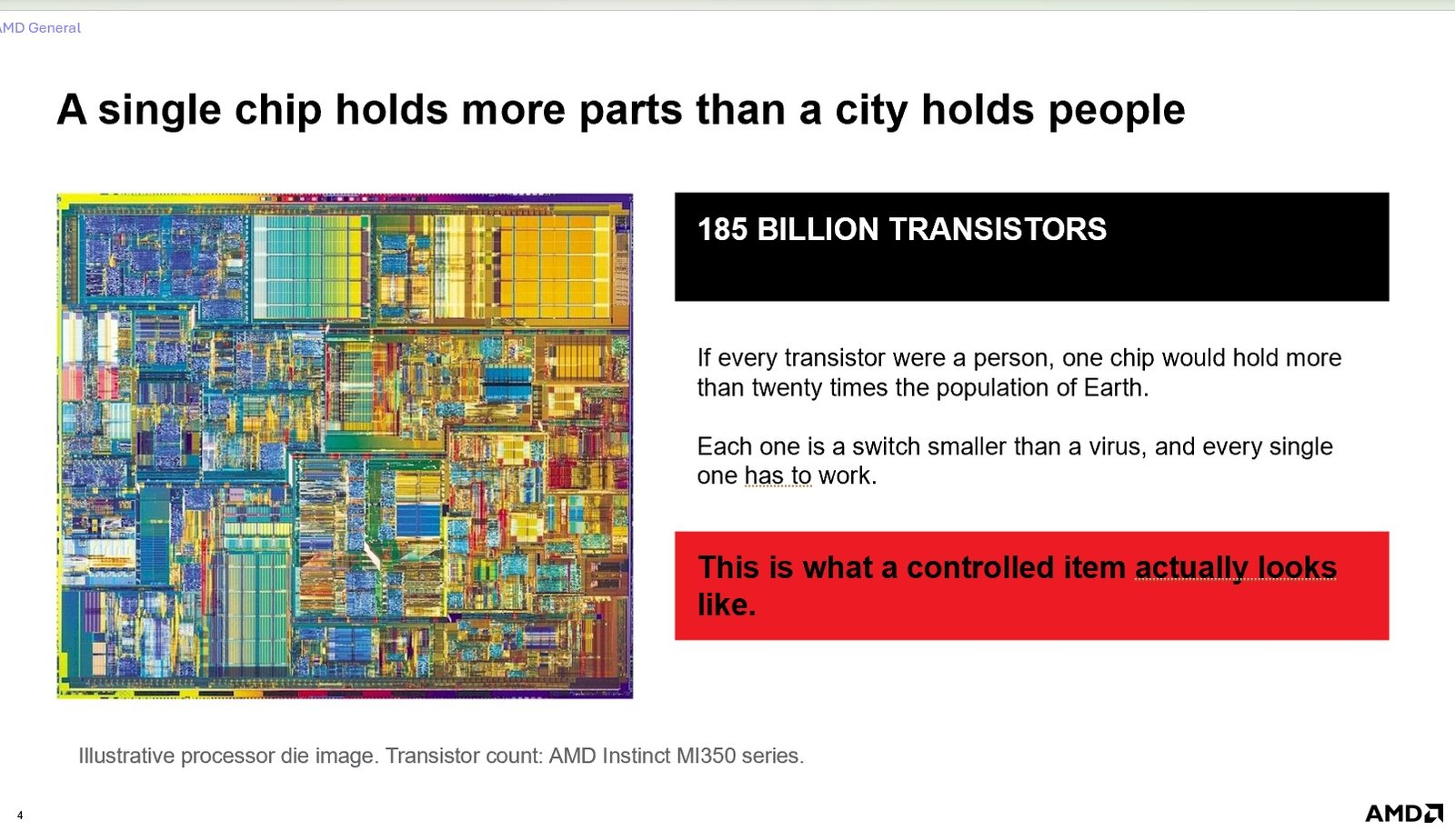
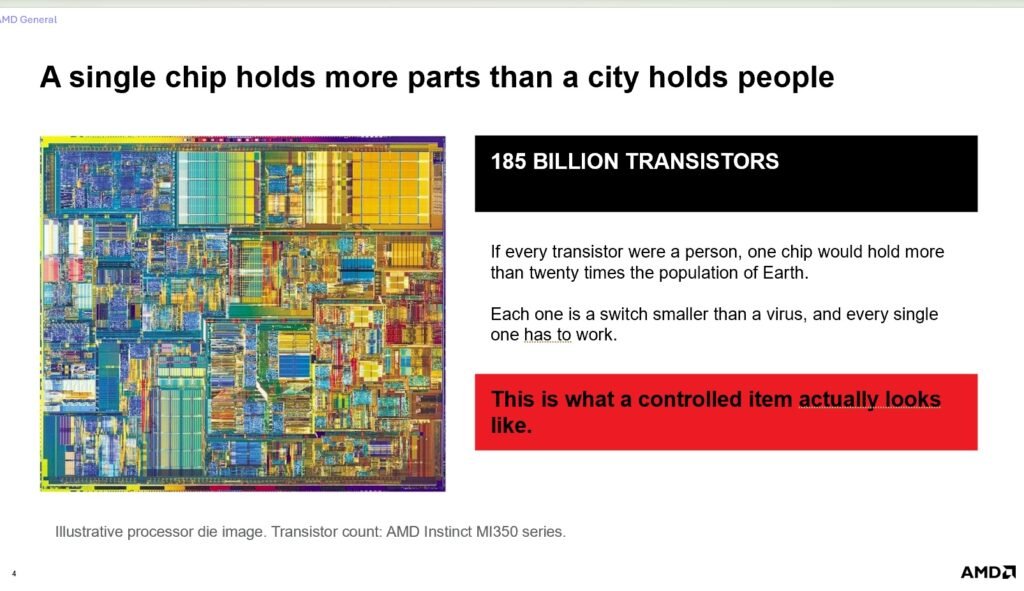
Then came perhaps the most memorable moment of the presentation. 185 billion transistors!
The audience was shown a magnified image of a processor die containing approximately 185 billion transistors.
Each transistor is effectively a tiny switch, and the presentation used a striking comparison: if every transistor were a person, one chip would contain more than twenty times the population of Earth.
When a trade professional sees an ECCN or considers whether an export-control rule applies to an AI accelerator, they are ultimately making a regulatory decision about a physical object of extraordinary technological complexity. The presentation deliberately connected those two worlds. Behind the classification is a product. And understanding that product matters.
The next step was to look inside the package itself.
The AMD Instinct MI355X was used as an illustration. The configuration shown contains eight compute dies, eight memory stacks and 288GB of HBM3E memory.
For the trade professional, this is where the origin question becomes particularly interesting: The finished product may contain multiple pieces of silicon manufactured in different places, at different facilities and potentially at different stages of the supply chain. But once assembled, those pieces become one product. As AMD’s presentation put it: “One package. Many origins. One classification.” That is precisely the kind of complexity that global trade professionals increasingly have to navigate.
From chip to AI system
AMD also moved beyond the individual accelerator to look at the wider AI infrastructure. The presentation distinguished between three layers:
- The chip: including the Instinct MI350 and MI400 series, used to train and run large AI models.
- The system: including Helios, which ships as a complete AI rack rather than as a loose component.
- The software: which enables customers to move between suppliers rather than being locked into a single hardware ecosystem.
For a trade audience, the physical scale of the system was particularly striking. Helios is described as a complete AI rack, roughly the size of a large wardrobe, with a value running into millions of dollars.
Suddenly, the phrase “technology export” feels very different. One product. Four jurisdictions.
The final part of the presentation brought everything together.
AMD illustrated a simplified journey:
Design: US and Europe
↓
Wafers: Taiwan
↓
Assembly: Asia partners
↓
Sale: Ireland
↓
Customer: Cloud providers and OEMs
The exact route varies by product line, but the illustration captures the fundamental challenge.
A single product can therefore have a deeply international manufacturing and commercial history.
Yet eventually, the complexity has to be translated into trade documentation.
- Origin.
- Classification.
- Licensing.
- Customs.
- Export controls.
AMD’s presentation offered something that is increasingly valuable in global trade education: technical context. Trade professionals do not necessarily need to become semiconductor engineers. But as technology becomes more sophisticated, understanding the products being traded becomes increasingly important. The presentation demonstrated why. When we talk about country of origin, we are talking about a physical manufacturing journey. When we talk about classification, we are talking about the characteristics and functionality of a physical product. When we talk about export controls, we may be talking about technology capable of powering some of the world’s most advanced AI systems. And when we talk about supply-chain risk, we are talking about a network of companies, facilities and jurisdictions that can stretch across continents.
The paperwork may be only a few lines long. The story behind it can span the globe.
AMD’s presentation was a valuable reminder that global trade does not happen in isolation from technology. The products moving through today’s supply chains are becoming more complex, more valuable and, in some cases, more strategically significant. That means trade professionals need the confidence to look beyond the declaration and understand what is actually moving. From 185 billion transistors to an AI rack worth millions of dollars, AMD gave the Global Trade Briefing audience a glimpse into the extraordinary technology behind the increasingly complex world of international trade.
And perhaps the most useful question to take away from the presentation is a simple one: Before we decide how to classify, control or declare a product, do we really understand what it is?
AMD’s presentation, “AMD: what we make, who buys it, and where it goes,” was delivered as part of the Global Trade Leadership Summit in September 2026 at AMD, Dublin. The presentation noted that its supply-chain examples were illustrative and that exact routes vary by product line.