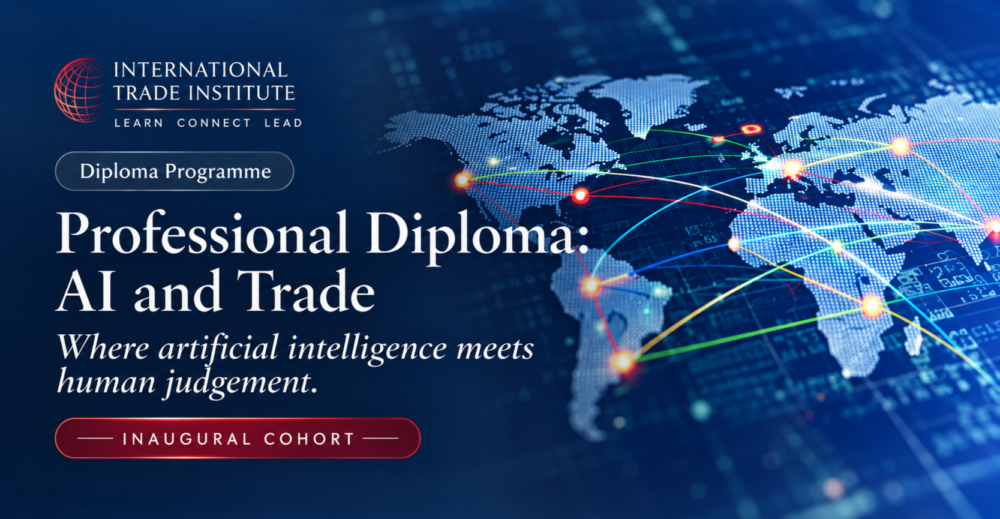
The International Trade Institute launches its inaugural Professional Diploma in AI & Trade, bringing together leading expertise in international trade law and artificial intelligence.
The future of international trade is being shaped by two powerful forces: geopolitical change and artificial intelligence.
As the global trading environment becomes increasingly complex, trade professionals must navigate evolving regulations, shifting economic priorities and new technological capabilities. Understanding how these forces intersect is becoming essential for organisations operating across borders.
Against this backdrop, the International Trade Institute (ITI) launched its inaugural Professional Diploma in AI & Trade on 14 October 2026, bringing together experts and practitioners to explore the implications of artificial intelligence for the international trade profession.
International trade in an age of uncertainty
The programme opened with a keynote from Professor Thomas Cottier, who examined the growing uncertainty surrounding international trade law and the pressures facing the multilateral trading system.
His session explored how the global trading environment has evolved, including the growing role of industrial policy, the challenges facing established trade rules and the implications of regulatory and geopolitical developments for international commerce.
For businesses, these developments create an increasingly demanding operating environment. Trade professionals must understand the rules governing cross-border transactions as well as the broader economic and political forces shaping them.
The emergence of artificial intelligence adds another important dimension to this challenge.
Understanding AI and its applications in international trade
The second session, led by Chen Cui, cofounder and CEO of Ginger Control, examined the fundamentals of artificial intelligence and its practical applications in international trade.
Participants explored how AI systems work, the capabilities of large language models, and the opportunities these technologies present for trade operations and compliance.
The discussion also addressed an essential consideration for businesses adopting AI: the limitations of these systems.
AI can produce convincing responses that contain inaccurate information. In customs and trade compliance, this may include incorrect legal references, outdated regulatory information or tariff classifications that do not reflect the requirements of the relevant jurisdiction.
These errors highlight why understanding the technology is as important as understanding its potential applications.
The importance of responsible AI adoption
For international trade organisations, the opportunity lies in applying AI where it can improve processes, support decision-making and strengthen operational capabilities, while retaining appropriate human oversight.
Effective implementation requires an understanding of data security, reliable information sources, regulatory requirements and the limits of automated outputs.
Professional expertise remains critical. AI can support the work of trade specialists, but organisations must ensure that its use is appropriately governed and that consequential decisions receive the necessary scrutiny.
As these technologies develop, trade professionals will increasingly need to combine their existing technical and regulatory knowledge with a practical understanding of AI.
Preparing the trade profession for what comes next
These themes underpin ITI’s Professional Diploma in AI & Trade. The programme brings together international trade expertise and emerging AI capabilities to help professionals understand the technology, explore its practical applications, manage associated risks and consider how to lead transformation within their organisations.
The inaugural cohort marks an important step in ITI’s commitment to supporting the development of knowledge and capabilities across the international trade profession.
ITI extends its thanks to Professor Thomas Cottier and Chen Cui for opening the programme with thought-provoking sessions, and to the inaugural participants for joining this exploration of a rapidly evolving field.
The future of international trade is evolving. Preparing the profession to navigate that change is an important part of the work ahead.
About the Professional Diploma in AI & Trade
The International Trade Institute’s Professional Diploma in AI & Trade explores the intersection of artificial intelligence and international trade through expert-led sessions covering AI fundamentals, practical applications, risk management, responsible AI and organisational transformation.
Find out more about ITI’s professional programmes and upcoming learning opportunities on our website.